Precision sheet metal fabrication is the backbone of modern physical hardware development in India. From lightweight EV battery enclosures and robotics chassis in Pune and Bengaluru to server rack cabinets and medical device housings in Delhi NCR and Noida, sheet metal delivers unmatched structural rigidity, thermal dissipation, electromagnetic interference (EMI) shielding, and scalability from rapid prototypes to high-volume production.
However, designing custom sheet metal parts requires a deep understanding of metal physics, mechanical deformation, and Design for Manufacturing (DFM) rules. Ignoring bend radius limitations, hole-to-edge clearances, or material elongation can lead to cracked flanges, distorted holes, assembly misalignments, and costly tooling reworks. In this definitive guide, ThinkToReality's engineering team provides a comprehensive breakdown of sheet metal design principles, bending mathematics, manufacturing processes, materials, and regional fabrication capabilities across India.
Applying DFM principles during early 3D CAD modeling in SolidWorks, Fusion 360, or PTC Creo ensures your sheet metal designs can be laser-cut, formed on press brakes, and welded with zero assembly defects:
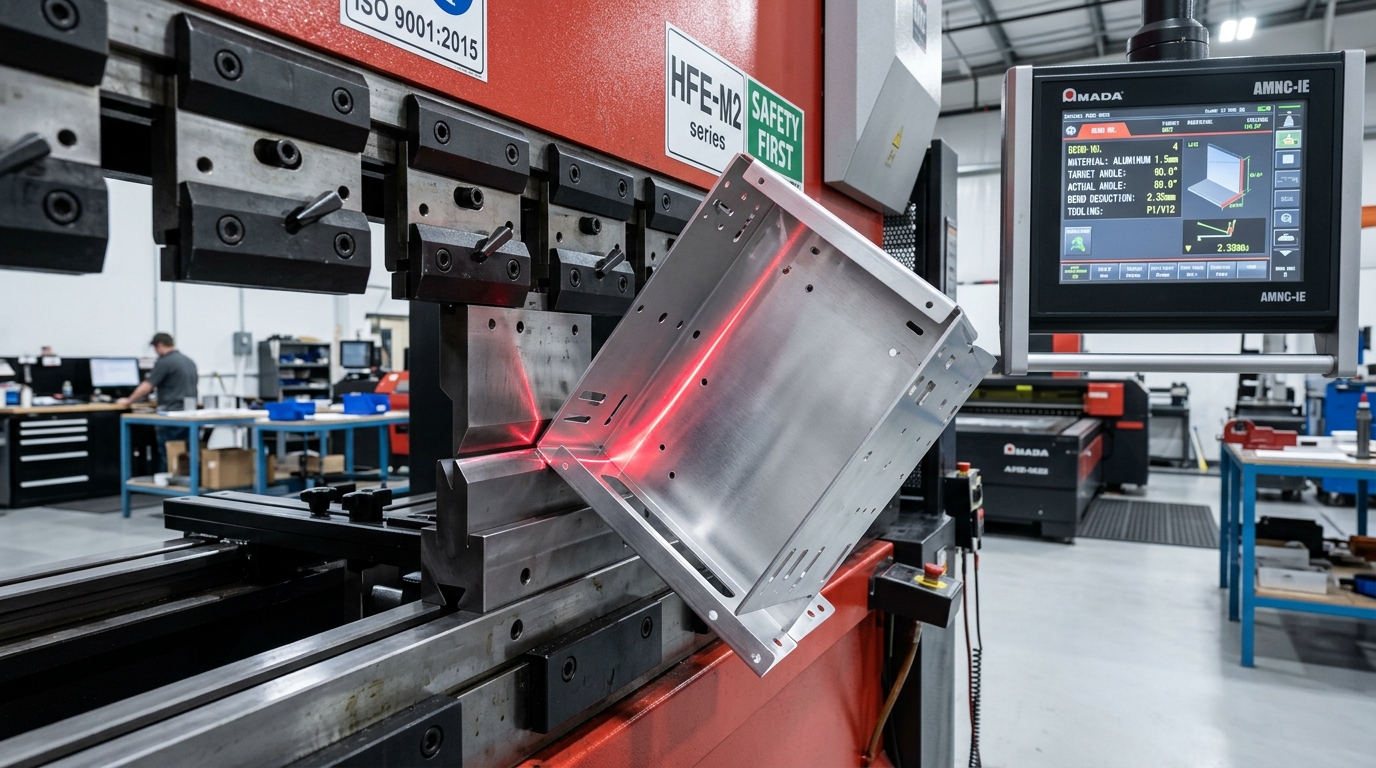
Precision CNC hydraulic press brake performing laser-guided 90-degree flange bending on an aluminum electronic enclosure at ThinkToReality facility.
Rule 1: Uniform Wall Thickness Throughout the Part: Every sheet metal component is fabricated from a single sheet of stock material. Ensure your CAD model maintains identical material thickness across all faces, flanges, and formed features.
Rule 2: Minimum Bend Radius (R ≥ T): The internal bend radius (IR) should ideally be equal to or greater than the sheet thickness (T). Bending metal with an inside radius smaller than 1T creates excessive localized stress along the outer bend face, causing micro-cracking and structural fatigue—especially in hard tempers like Aluminum 6061-T6 or Stainless Steel 304.
Rule 3: Minimum Flange Length (L ≥ 4T + R): If a bend flange is too short, the sheet will not sit securely against the lower V-die opening on the press brake during bending, causing uneven angle slips and poor dimensional control. Always maintain a flange height of at least 4 times the material thickness plus the bend radius.
Rule 4: Hole & Slot to Bend Distance (D ≥ 2.5T + R): When a hole or slot is positioned too close to a bend line, the stretching of metal during press brake forming pulls and deforms the hole into an oval. Keep all pierced cutouts at a minimum distance of 2.5T to 3T away from the bend tangent line.
Rule 5: Corner Bend Relief Notches: When two bends meet at a corner, the overlapping metal undergoes extreme compression. Incorporating rectangular or circular bend relief notches with a width equal to material thickness (T) and depth greater than bend radius (R) prevents tearing and allows the corner seams to mate flush.
When flat sheet metal is bent on a press brake, the outer surface is stretched under tension while the inner surface is compressed. Somewhere between these two zones lies the Neutral Axis, a plane that experiences zero change in length. Understanding how to calculate flat pattern development is crucial for achieving tight ±0.2 mm manufacturing tolerances:
K-Factor (K = t / T): The ratio of the neutral axis position (t) to the total material thickness (T). For standard mild steel and aluminum air bending on CNC press brakes, the K-Factor typically ranges between 0.33 and 0.45.
Bend Allowance (BA Formula): The total arc length of the neutral axis through the bend angle (A in degrees):
BA = (π / 180) × A × (R + K × T)
Bend Deduction (BD Formula): The amount of material to subtract from the sum of external flange dimensions to calculate the exact flat blank cutout length:
BD = 2 × (R + T) × tan(A / 2) - BA
At ThinkToReality, our CAM nesting engineers calibrate these bend deductions directly into CNC Trumpf and Amada press brake controllers to ensure first-article prototyping accuracy.
Precision sheet metal manufacturing combines cutting, forming, joining, and hardware insertion operations:
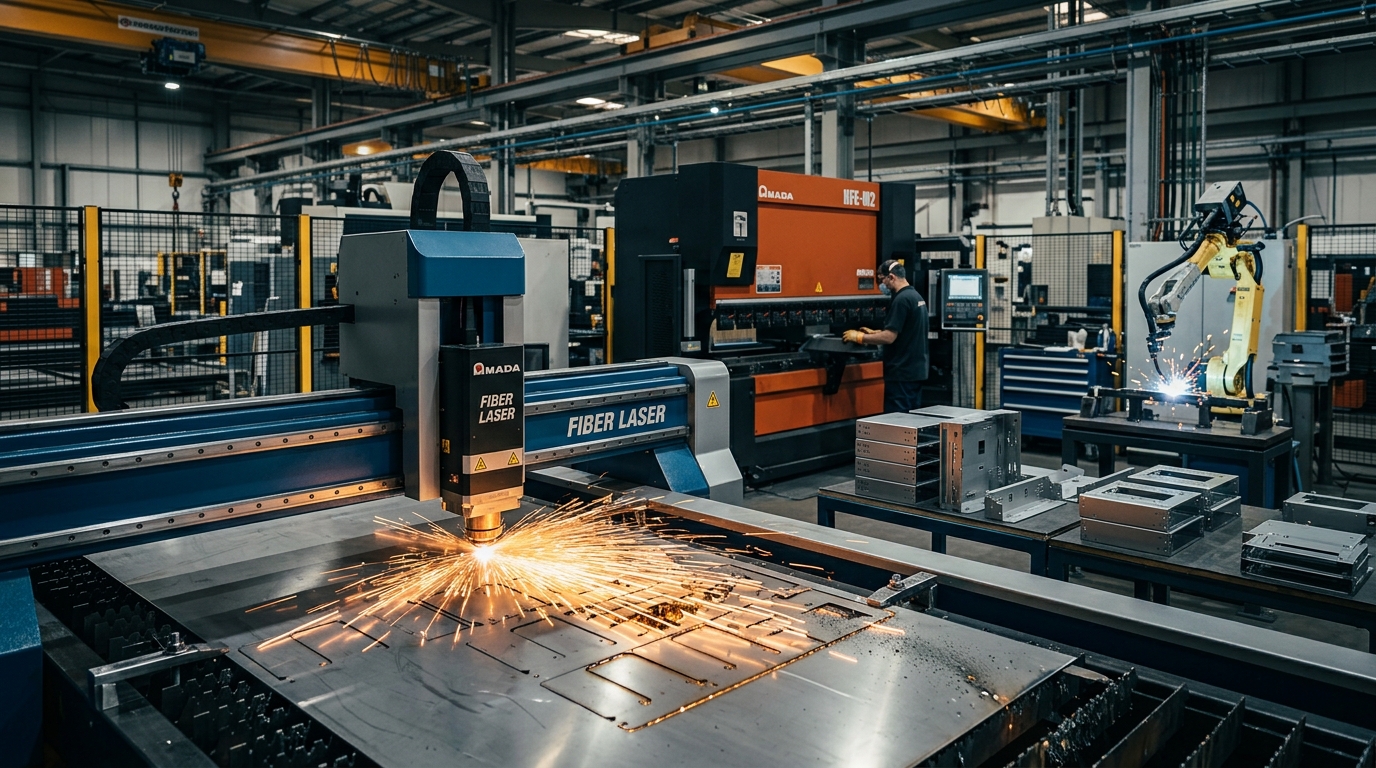
1. High-Speed CNC Fiber Laser Cutting: Fiber lasers utilize solid-state optical fibers to concentrate high-density energy beams, delivering clean dross-free edge cuts with narrow kerf widths (±0.05 mm precision). It cuts mild steel up to 20mm, stainless steel up to 16mm, and reflective metals like aluminum, brass, and copper without mechanical distortion.
2. CNC Multi-Axis Press Brake Bending: Hydraulic and electric multi-axis press brakes use precision segmented top punches and bottom V-dies to execute multi-stage bends, offset joggles, large-radius radius bends, and flattened hemming edges.
3. CNC Turret Punching & Embossing: High-speed mechanical punching creates repetitive perforations, ventilation louvers, countersunk embosses, card-guide extrusions, and localized rib stiffeners in high-volume production batches.
4. Precision TIG / MIG & Robotic Spot Welding: Structural sheet metal assemblies are permanently joined using tungsten inert gas (TIG) for aesthetic, leak-proof corner joints, metal inert gas (MIG) for heavy structural frames, or resistance spot welding for overlapping sheet brackets.
5. PEM Hardware Fastener Insertion: Pneumatic press machines insert flush-mount self-clinching threaded standoffs, studs, blind nuts, and captive panel screws directly into laser-pierced holes, eliminating weak manual tapping in thin gauge metals.
Selecting the appropriate alloy depends on your structural strength, weight targets, corrosion resistance, and post-processing needs:
CRCA Mild Steel (Cold Rolled Close Annealed - IS 513 / SPCC): The most cost-effective engineering steel with excellent formability, smooth surface finish, and high structural strength. Ideal for indoor electrical server racks, machine frames, and appliance chassis when paired with powder coating.
Stainless Steel 304 / 304L: Austenitic stainless steel containing 18% Chromium and 8% Nickel. Exceptional corrosion resistance, high tensile strength, and hygienic properties. Used for food processing machinery, medical enclosures, and outdoor electronic cabinets.
Stainless Steel 316 / 316L: Formulated with 2% Molybdenum for superior resistance against harsh chlorides, acids, and marine saltwater environments. The gold standard for chemical processing and marine hardware.
Aluminum 5052-H32: The premier sheet metal alloy for electronic enclosures and chassis. Combines lightweight density (1/3rd the weight of steel), superior bendability without cracking, high fatigue strength, and natural corrosion resistance.
Galvanized Steel (GI / GP Sheets): Zinc-coated steel providing low-cost cathodic corrosion protection for HVAC ducting, industrial electrical junction boxes, and automotive underbody brackets.
Surface treatments protect raw fabricated metal against environmental degradation while delivering premium brand aesthetics:
Electrostatic Powder Coating: Thermoset polymer powders (epoxy, polyester, polyurethane) are electrostatically sprayed and heat-cured at 200°C into a rugged, chip-resistant finish available in glossy, matte, textured, or fine-structure RAL shades.
Anodizing (Type II & Type III Hardcoat for Aluminum): Electrochemical oxidation creating a durable, wear-resistant ceramic surface layer that can be dyed in black, silver, champagne, or custom corporate colors.
Zinc Electroplating & Trivalent Passivation: Hexavalent-free zinc plating (RoHS compliant clear blue, yellow, or black passivation) providing 240+ hours of ASTM B117 salt spray corrosion resistance for internal fasteners and mild steel brackets.
Brushed Grain & Bead Blasting: Uniform directional #4 satin brushing or fine glass bead blasting to eliminate laser heat-affected zones and create an ultra-modern consumer electronics appearance.
India's rapid industrialization has established key regional manufacturing corridors, each with specialized sectoral demands:
Delhi NCR, Noida & Greater Noida (Sector 63, Sector 80, Ecotech, Govindpuri, Okhla): The innovation hub for IoT devices, smart consumer hardware, EV charging stations, and medical diagnostic equipment requiring rapid prototype iterations and tight-tolerance custom sheet metal enclosures.
Gurgaon, Manesar & Faridabad (IMT Manesar, Udyog Vihar): Leading automotive, heavy tooling, and robotics belt demanding high-durability welded frames, chassis sub-assemblies, and robotic automation cell guards.
Pune & Pimpri-Chinchwad (Bhosari, Chakan, Talegaon): India's premier automotive and precision engineering cluster, driving high demand for structural laser-cut sheet parts, deep-drawn components, and batch stamping.
Bengaluru & Hyderabad (Peenya, Whitefield, Electronic City): Aerospace, defense, space-tech, and telecom server manufacturing demanding micron-level dimensional inspection, AS9100D quality standards, and MIL-spec surface treatments.
Chennai & Ahmedabad (Oragadam, Sriperumbudur, Sanand, Changodar): Heavy commercial EV manufacturing, solar inverter cabinets, and energy infrastructure installations.
ThinkToReality empowers hardware startups, product designers, and OEM manufacturers across India by simplifying complex sheet metal procurement. By uploading your 2D DXF or 3D STEP files to our digital quoting platform, you receive instant DFM feedback, material yield optimization, transparent pricing, and express manufacturing dispatch within 2 to 5 business days under strict NDA confidentiality terms.